Why robots, not drones?
Cleaning drones spray from a distance. Our robots hold onto the building and clean by contact. Here is why that matters on tall glass, and where drones still win.
Oct 20, 2026 · 6 min read
A cleaning drone never touches the glass. That is its selling point. On a tall tower, it is also its problem.
We clean facades with robots that hold onto the building. People ask us every week why we do not just use drones. It is a fair question, so here is the long answer, including where drones are the better tool.
How a cleaning drone actually cleans
Most cleaning drones are tethered. The aircraft carries a nozzle. The pump, the water and the cleaning solution stay on a truck on the ground, and a hose pays out as the drone climbs.
It cleans by spraying from a few feet away, usually as a soft wash: low pressure, with the chemistry doing the work, then a rinse with purified water so the glass dries without spots.
That is clever engineering, and for a lot of buildings it works. But everything that follows comes from two facts: it never touches the surface, and it is connected to the ground.
What spray cannot do
Purified water rinses routine dust off flat glass without a squeegee. Good.
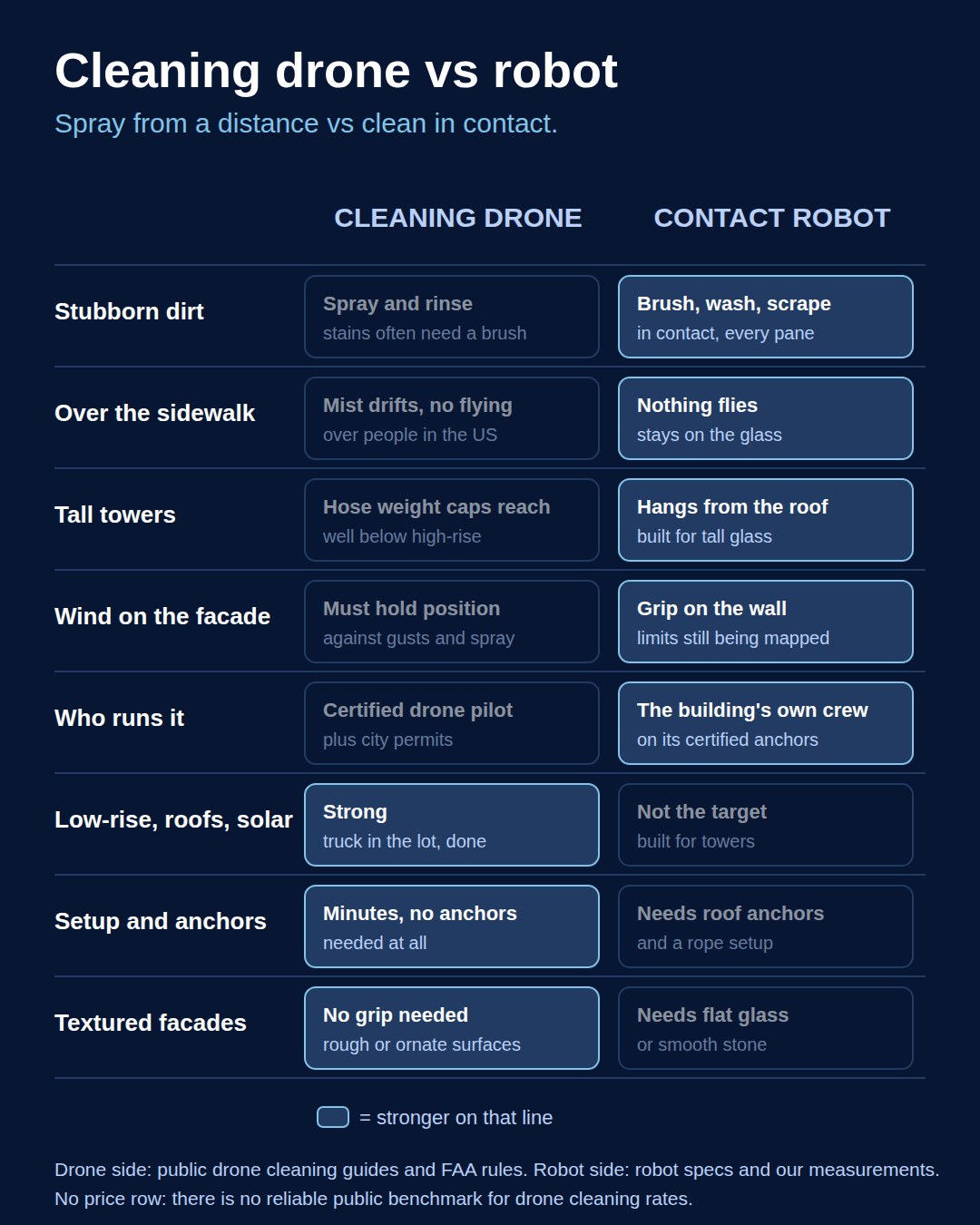
Some dirt does not rinse. Independent guides on drone window cleaning say it plainly: hard water stains, construction residue and bird droppings often need a brush. A spray from a few feet away cannot scrub a recessed corner the way a hand can.
Window cleaners have always cleaned by contact for that reason: wet, agitate, scrape. A rope technician on the facade does exactly that.
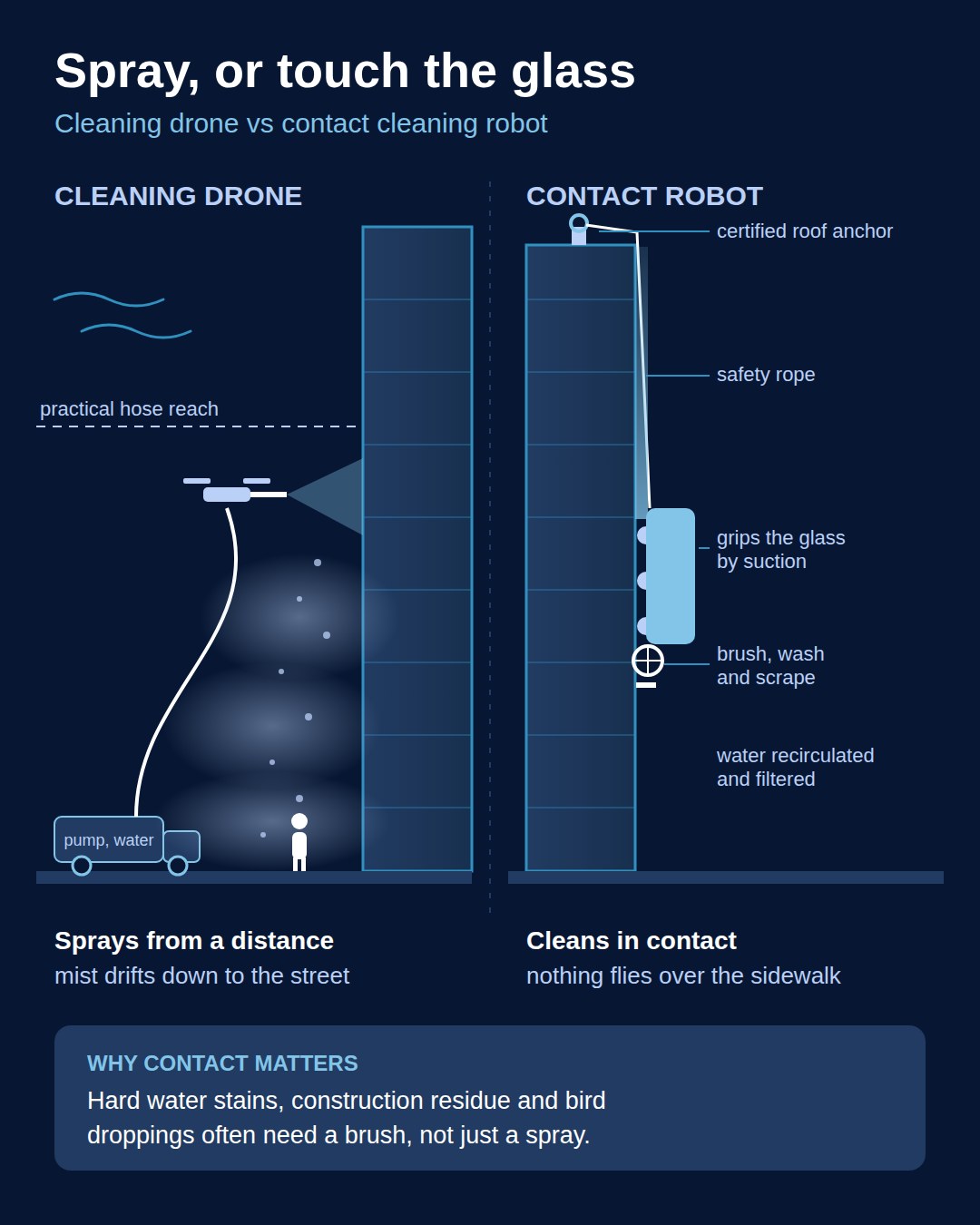
Our cleaning robot does the same thing mechanically. It holds onto the glass by suction, and it brushes, washes and scrapes each pane as it goes. It cleans by touching the building, the way the trade always has.
The street under the building
Spray goes somewhere.
Drone cleaning guides warn that mist drifts onto parked cars, patio furniture and neighboring properties, that hypochlorite overspray bleaches landscaping and fabric, and that rooftop air intakes can pull mist into the building.
Then the rules. In the United States, a small drone may not fly over people unless they are part of the operation, under cover, or the flight meets specific FAA categories. Over a busy downtown sidewalk, that means closing the area or not flying there. A drone also may not carry hazardous material under FAA rules, which puts some common cleaning chemistries in a gray zone that operators have to check product by product. And in New York City, a drone takeoff or landing needs an NYPD permit, applied for at least 30 days ahead.
Our robot does not fly. It stays on the glass, on a safety rope, and it is designed to recirculate and filter its own water rather than throw it into the air. Nothing hovers over the sidewalk.
Height and wind
A tethered drone has to lift its hose. Drone cleaning guides note that hose weight and pump pressure set the practical limit, and that most tethered systems top out well below high-rise heights. Above that, buildings go back to rope access or a platform.
Wind is the other limit. It accelerates around corners and creates updrafts and downdrafts along facades, and the wind at the roofline can be very different from the forecast on the ground. A drone has to hold its position in that air while pushing back against its own spray.
A robot gripping the glass on a rope from the roof is in a different situation: its weight hangs on the rope and its grip is on the wall. We are still mapping our own weather limits building by building, so we will not throw numbers around. But the failure mode is different.
Who runs it
This matters more than people think.
Tall buildings already have certified roof anchors, and contractors who use them every season: rope access crews and window cleaning companies who know the building, the anchors and the owner.
Our robot fits into that. It hangs from the same certified anchors, on a safety rope, and it is run by the crew that already services the building. Nobody gets replaced. The crew spends less time hanging over the void and lets the machine do the repetitive flat glass.
Measured on curtain-wall towers, it covers about 200 square metres per hour. That is a measured number, on flat glass, and we would rather quote it than a brochure figure.
What about cost
Honestly, there is no reliable public benchmark for drone cleaning rates. Pricing is quoted per square foot, per window or per building, and most published savings claims come from vendors. So we will not compare prices we cannot verify.
What we can share is the bar we set ourselves. The robot is leased to the contractor, and its cost per square metre has to be at or below what a rope team costs today, while the same crew covers more facade. If it does not clear that bar, it does not belong on the building.
Where cleaning drones win
We would rather say this ourselves.
Drones win on low-rise buildings: a few stories, a truck in the parking lot, done before lunch.
They win on a quick spray of hard-to-reach spots: an awning, a canopy, a sign, a setback nobody can get to.
They win on roofs and large solar arrays, where the alternative is a crew walking on a surface they should not walk on.
They need no roof anchors at all, and our robot cannot work without them. They win on setup speed: unload, tether, fly.
And they handle textured or ornate surfaces our robot cannot grip, since suction needs flat glass or smooth stone.
If that is your building, use a drone. Seriously.
The bonus: every wash can also be a scan
There is one more thing a machine on the glass can do. It passes over every pane, on the same path, several times a year.
We are building a camera module that rides on the cleaning robot, so a wash can also be a scan of the facade. Cleaning pays for the visit, and the facade condition data comes with it. That part is still in development, and we will show it when it is ready.
Where we are
We are not claiming drones are useless. They are great at what they were built for.
We are betting that on tall glass, the machine that holds onto the building, cleans it by contact, and is run by the crew that already has the keys to the roof is the one that wins.
If you own, manage or clean tall buildings, we would like to hear how you handle facade cleaning today, and what you would need to see before putting a robot on your glass. Write to us at contact@vitrobot.site.